Belief as Subject
You are looking through the belief, so it feels like reality rather than an interpretation. Because you cannot yet see it, questioning the belief can feel like questioning who you are.
Human Operating System
The Human Operating System maps the six interconnected systems that shape how you interpret a situation and respond: environment, behavior, decisions, cognition, belief, and awareness. It matters because the decision or behavior you can see is often being produced by something you cannot. Horizontal operation reveals what is interacting. Vertical integration creates the capacity to observe, examine, reconstruct, and eventually embody a different way of operating.
You are looking through the belief, so it feels like reality rather than an interpretation. Because you cannot yet see it, questioning the belief can feel like questioning who you are.
You can see the belief as something you hold rather than something that defines reality. That distance lets you examine its origin, evidence, function, and consequences—and decide whether to retain, revise, or replace it.
Developmental position
Awareness creates distance from the contents of the self. The person begins to notice the belief rather than unconsciously seeing through it.
Choose a dimension of the Human Operating System
Vertical integration makes durable change possible
Why Understanding It Matters
A recurring decision, conflict, habit, or performance gap can be produced at different levels of the system. The constraint may be an inaccurate belief, a distorted interpretation, competing priorities, missing capability, relationship dynamics, or the environment itself. The Human Operating System helps identify which part is actually driving the result.
The HOS is not a personality test, a clinical diagnosis, or the change process itself. It is a working map for separating what is happening around you from how you are interpreting it, deciding within it, and acting because of it.
HOS Maps the System. Vertical Integration Changes Your Relationship to It.
Horizontal operation shows how the six systems interact in the present. Vertical integration is the developmental work required to change what those systems can hold and produce. What was once fused with identity becomes observable. What becomes observable can be examined. What can be examined can be reconstructed, practiced in the real environment, and stabilized through feedback until a different response remains available under pressure.
Identified→Witnessing→Examining→Reconstructing→Embodying
Separate external conditions, internal interpretation, decision-making, and visible behavior instead of collapsing them into one explanation.
Determine whether the problem originates in belief, cognition, priorities, capability, relationships, incentives, or the environment before prescribing change.
Intervene at the right level, act differently in the real environment, and use consequence and feedback to determine whether the system actually changed.
How It Connects to the Work
In coaching, the Human Operating System explains what we examine. Vertical integration describes the developmental movement required for durable change. ADAPT provides the repeatable process for assessing the system, reconstructing what must change, acting in the real environment, and using feedback to stabilize a different result.
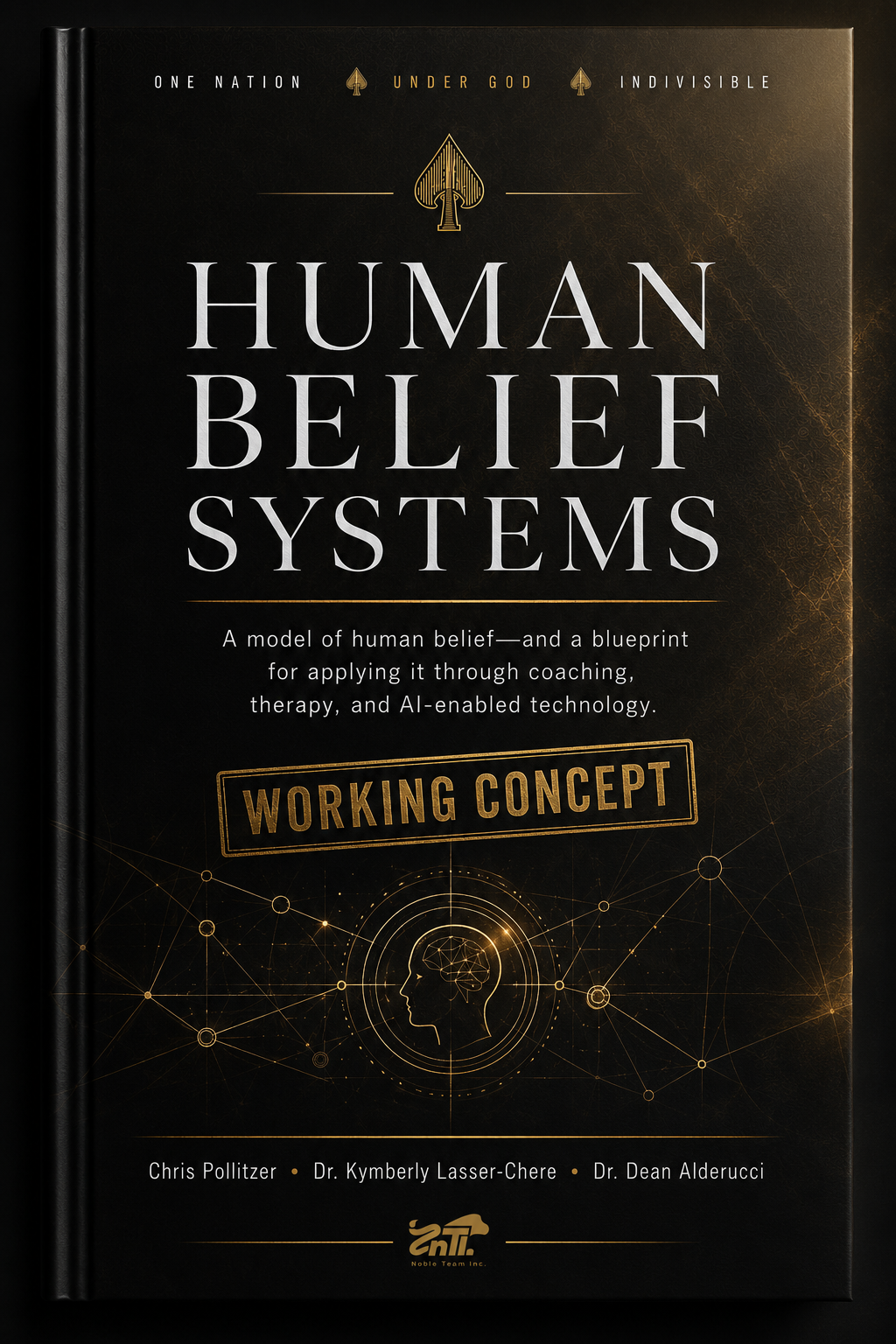
Human Belief Systems establishes the intellectual framework behind this work: an interdisciplinary model of how beliefs are formed, reinforced, challenged, and intentionally changed. It brings behavioral science, neuroscience, clinical practice, systems thinking, mathematics, and artificial intelligence into one coherent architecture.
The framework is being developed by Chris Pollitzer and Leonard Mello with Dr. Kymberly Lasser-Chere and Dr. Dean Alderucci. Together, the team connects practical coaching, clinical depth, responsible technology, and a usable model of change without confusing one discipline for another.
The book establishes the model. The future platform will make it usable at greater depth and scale through AI-assisted pattern recognition and two distinct forms of human expertise. Coaching translates insight into better decisions, behavior, leadership, and performance. Dr. Kymberly Lasser-Chere’s separately delivered clinical work provides the therapeutic depth required for trauma, attachment, nervous-system dysregulation, and deeply embedded patterns that coaching cannot responsibly resolve. Technology supports continuity and pattern recognition; it does not replace either practitioner or blur the boundary between coaching and therapy.
Join the waitlist for publication updates, research developments, and early announcements connected to the book and the platform being built around it.